

A flat sealing gasket is a planar seal positioned between two independently connected components, designed to prevent medium leakage between them or ensure that leakage remains within permissible limits throughout the intended service life.
Principle of the Sealing Gasket
The sealing gasket deforms upon compression, achieving sealing by filling the irregularities (surface roughness) on the equipment surface, with its compression load exceeding the medium pressure.
There are primarily two types of leakage patterns in sealing gaskets:
A-Leakage through the sealing gasket and contact surfaces of the equipment; this is the most common and predominant leakage mode.
B-Permeation occurring through the interior of the gasket; this mode of permeation is primarily related to the material of the gasket.
Connection types for non-metallic flat seals and flanges
Structurally, flanges using non-metallic flat sealing gaskets can be classified into four types: full-flat (FF type), convex (RF type), concave-convex (MF type), and tenon-groove (TG type).
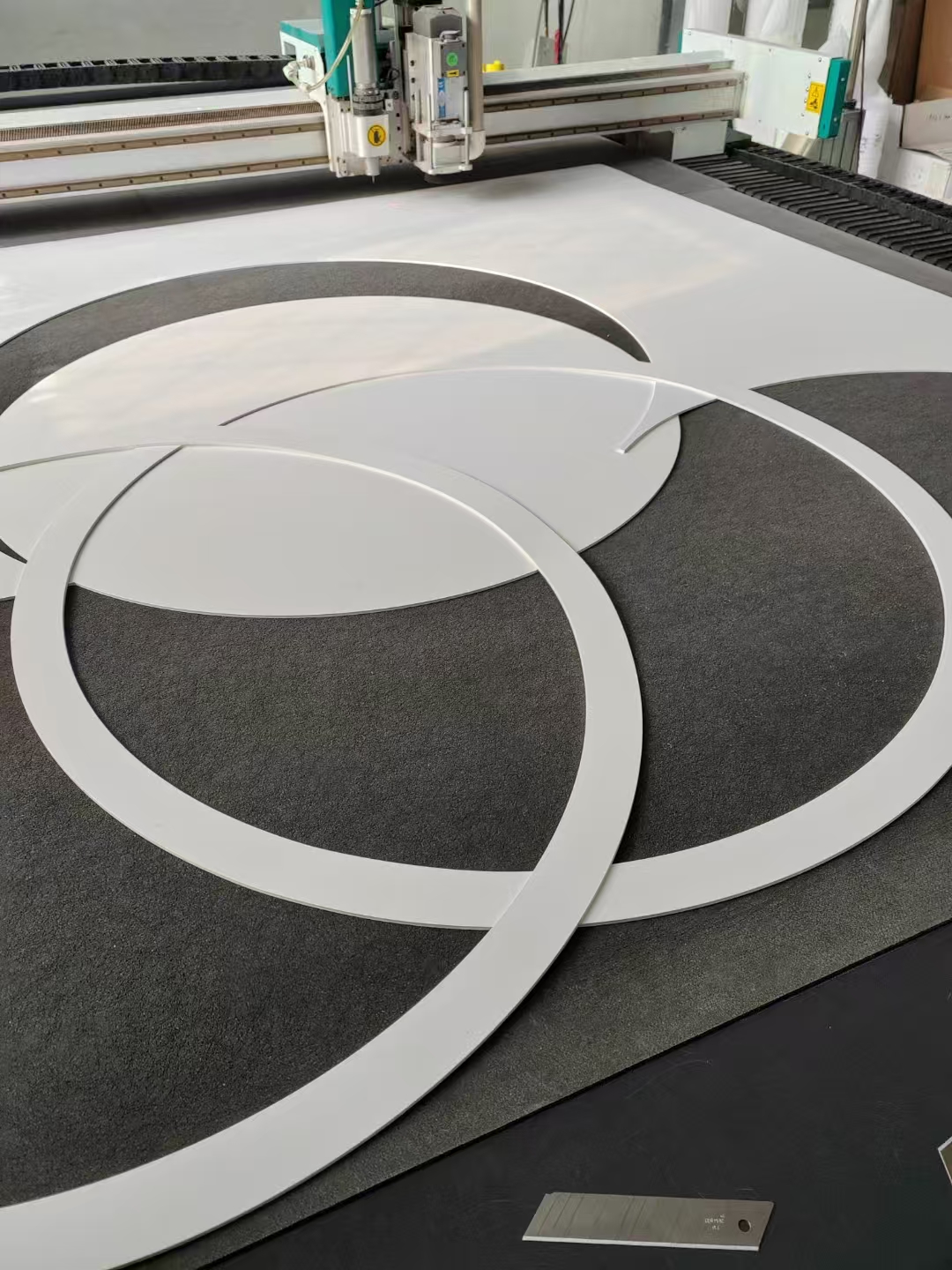
The most common materials for non-metallic flat sealing gaskets are:
Elastomer Sealing Gasket
Non-asbestos Fibre Sealing Gasket
PTFE Sealing Gasket
Elastomer Sealing Gasket
Merit:
Excellent compensatory properties;
Extremely low permanent deformation under compression (≤8%);
Excellent sealing performance;
Can be used for areas with minor vibrations, slight corrosion, or deformation;
On-site cutting and processing are convenient.
Disadvantages: Low pressure resistance (it is recommended to use a pressure not exceeding 1.6 MPa).
Application scenarios: air coolers, transformers, low-voltage pipelines, and other flat sealing applications.
Non-asbestos Fibre Sealing Gasket
Merit:
Good compensatory nature;
A wide range of applicable temperature conditions;
Can be used for areas with minor vibrations, slight corrosion, or deformation;
Free from asbestos, safe and environmentally friendly.
Disadvantages: Not suitable for extremely high pressures (use pressure should not exceed 10 MPa).
Application: For sealing various pipeline flanges and flat end surfaces.
PTFE Sealing Gasket
Merit:
Excellent dielectric resistance;
Excellent temperature resistance (-220°C to 250°C);
Excellent insulation properties;
Excellent pressure resistance (up to 25 MPa);
Disadvantages: The compensation effect is generally moderate; high flatness requirements are imposed on the flange surface; on-site processing is relatively challenging.
Application: For sealing various pipeline flanges and flat end surfaces.
Basic Principles for Selection
When selecting a planar seal, the two most critical considerations are its service life and sealing performance requirements.
Temperature: Includes operating temperature and rated temperature range, which determine the material type.
Pressure: Determines the type, hardness, and dimensions of the material.
Media: Determining the material type reflects its chemical interaction with the seal. If the medium is highly corrosive or requires stringent cleanliness standards, specialized sealing materials must be selected.
When selecting sealing components, it is essential to prioritize parameters, as it is difficult for any single material or structure to meet all requirements simultaneously.
For applications requiring high sealing performance, materials with superior compensatory and elastic properties should be prioritized; however, this approach sacrifices some compressive strength.
When temperatures are high, high-temperature-resistant materials should be prioritized.
Regardless of the sealing type selected, identifying the primary requirements is paramount.
In summary, the selection of gasket dimensions depends on the flange dimensions, surface roughness, medium type, pressure, temperature, and sealing material.